The Sustainability of Hatred
(Die Nachhaltigkeit des Hasses)

My work begins with visualizing individuals and groups shaped by isolation and closed systems. How does an individual change under the influence of society, the state, ideology, and history? How do long-standing boundaries become embedded in culture and identity? Through various media, I have explored these questions.
The Sustainability of Hatred examines contemporary South Korean society through the lens of a division that has persisted since the Korean War. Although the war came to a halt with the armistice in 1953, it has never truly ended. The ideological boundary created by the conflict continues to shape everyday life. Two societies that once shared the same language and culture have remained separated under radically different political systems for more than seventy years. One became increasingly closed in order to preserve its political system, while the other experienced rapid economic growth and globalization. As a result, the two societies have developed entirely different cultures and values. Yet the hostility and tension born from division continue to endure.
One of the clearest traces of this history can be found in South Korea's system of compulsory military service. Most South Korean men serve in the military around the age of twenty. The figures in the photographs are all the same person. In one image, he wears ordinary clothes; in another, a military uniform. The face remains the same, yet the gaze, the posture, and the social meaning attached to the body are transformed. Through these subtle differences, I examine the traces that the state and ideology leave upon individual identity.
The sound installation juxtaposes North Korean propaganda songs with South Korean K-pop. Produced within two fundamentally different political systems, these contrasting musical forms symbolize the divergent societies that have emerged since division. On one side, music continues to function as a tool of ideological mobilization; on the other, popular music has evolved into a global cultural industry. As these sounds collide within the same space, they reveal an invisible border and the collective identities constructed on either side of it.
The gun displayed in the exhibition is completely covered with countless stickers, stripped of its original function while retaining only its recognizable silhouette. It is no longer simply a weapon, but a symbol of hatred and ideology that have been reproduced and consumed over time. Its surface may change and its function may disappear, yet its form remains unmistakable. Hatred operates in much the same way. Societies evolve and history moves forward, but the emotions and memories produced by outdated ideologies continue to reappear in new forms.
This work is not intended as a criticism of any particular nation or political system. Rather, it asks how division and ideology leave lasting traces on individual lives and cultural memory, and how historical experiences repeated across generations become embedded within collective identity.
Borders do not exist only on maps. They continue to inhabit our bodies, our memories, our cultures, and our everyday lives.
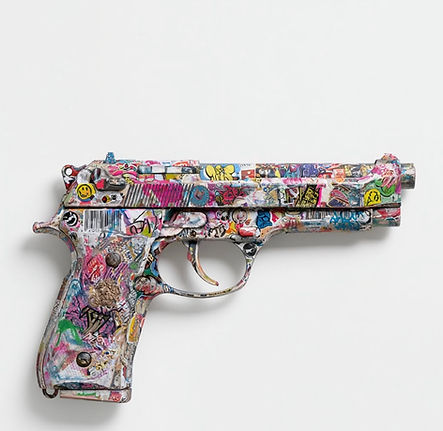
The Sustainability of Hatred (Die Nachhaltigkeit des Hasses)
2026 Mixed Media Object Replica Pistol, Vinyl Stickers

The Sustainability of Hatred(Die Nachhaltigkeit des Hasses)
2026 Mixed Media Object Replica Pistol, Vinyl Stickers

The Sustainability of Hatred(Die Nachhaltigkeit des Hasses)
2026 Mixed Media Object Replica Pistol, Vinyl Stickers

Mao 2026 2026 Mixed Media Installation

Border, 2026 ,Digital C-print

Border, 2026 ,Digital C-print